 Verve45 Editorial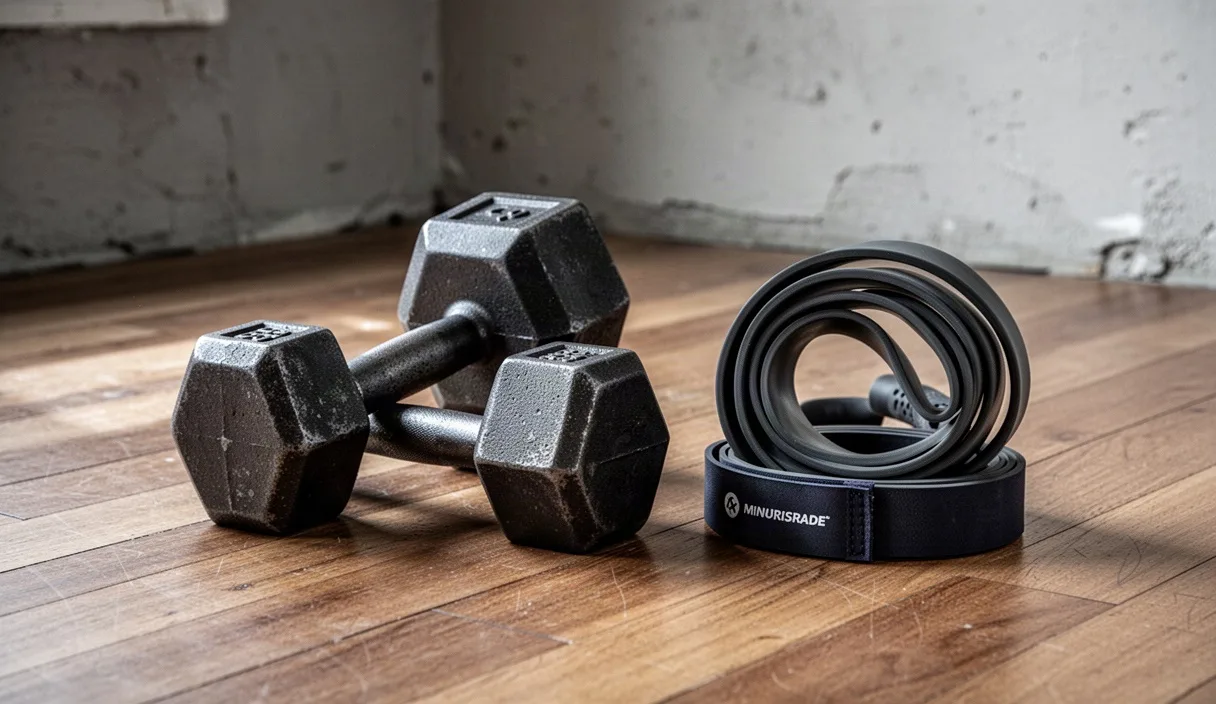
A barbell holds the same mass whether it rests on the floor or sits at shoulder height. A rubber loop generates almost no force when slack, but resists with high force when stretched to double its resting length. That mechanical difference changes how your muscles, joints, and connective tissues handle stress during a training session.
After age 45, muscle recovery slows down, articular cartilage thins, and bone mineral density declines at measurable rates. Choosing between iron weights and elastic resistance is not a matter of picking one camp. It is a matter of matching the right tool to the joint angle, the connective tissue status, and the training goal of the day.
Load distribution differences between elastic and gravitational resistance
Free weights rely on gravity. Gravity acts purely in a vertical direction toward the floor. When you hold a 10-kilogram dumbbell during a bicep curl, the load is always 10 kilograms downward. However, the internal torque on your elbow joint changes as your forearm moves. The movement feels hardest when your forearm is horizontal, at roughly 90 degrees of flexion, because the lever arm between the weight and your elbow joint is at its longest distance.
Resistance bands rely on Hooke's law of elasticity. The resistance increases linearly as the elastomer stretches. A flat loop band with a 13-millimeter width might exert 4 kilograms of tension when pulled 20 centimeters past resting length, but 11 kilograms of tension when pulled 80 centimeters. Because bands do not rely on gravity, the direction of resistance runs parallel to the line of the band itself, rather than straight toward the floor. You can anchor a band to a door post to pull horizontally, diagonally, or upwards.
This difference alters the resistance curve of every exercise. In a barbell squat, the movement is hardest at the bottom of the descent, where your quadriceps are elongated and your hip joints are flexed under maximum leverage. In a banded squat, the load lightens as you descend toward the floor, and peaks at the very top as you stand tall and lock your hips. The table below outlines how these two loading mechanisms behave across joint ranges.
| Mechanical Factor | Free Weights (Dumbbells and Barbells) | Elastic Bands (Loop and Tube) |
|---|---|---|
| Direction of load | Vertical only, directed toward the ground. | Along the band axis, determined by anchor point. |
| Peak resistance point | Where the lever arm is perpendicular to gravity. | Where the elastic material reaches peak stretch. |
| Bottom of joint range | Highest mechanical disadvantage under static load. | Lowest tension as the band returns toward resting slack. |
| Momentum effects | Mass can be swung; momentum reduces muscle work. | No momentum; elastic recoil requires constant control. |
Tendon tolerance and joint safety profiles past 45
Tendons and ligaments adapt to stress at roughly one-third the speed of skeletal muscle tissue. After age 45, the water content in tendon collagen drops, and the collagen fibers cross-link with advanced glycation end products. This process makes the tendons stiffer, but less pliable under sudden, violent shifts in load. When an adult over 45 uses free weights, the bottom portion of a movement often places maximum load on a tendon when it is fully stretched across an open joint capsule.
Dumbbells can produce microtrauma at these extreme ranges. For example, in a flat dumbbell chest press, the bottom position forces the humerus into deep horizontal abduction. The pectoralis major tendon takes the full weight of the dumbbell while under peak elongation. If shoulder mobility is compromised by acromioclavicular joint mobility or rotator cuff fraying, this bottom position often creates impingement symptoms and chronic tendinopathy.
Elastic bands lower the tension at this deep range of motion. During a banded chest press, the band is slackest when your hands are touching your ribs, sparing the anterior shoulder capsule and the biceps tendon. The resistance increases smoothly as your hands push outward, reaching maximum load near full elbow extension. At this terminal position, the shoulder joint is structurally stable, the scapula is supported by the serratus anterior, and the muscles can contract hard without grinding the joint surfaces.
Bands also demand greater stability from secondary stabilizer muscles. Because the band wants to snap back toward its anchor, your joint must continuously resist oscillation throughout both the eccentric and concentric paths. This continuous tension trains the rotator cuff in the shoulder and the deep rotators of the hip without forcing high peak shears into the cartilage.
Bone mineral density response to iron weights versus bands
Bone remodels according to Wolff's law. Mechanical compression and tension on the skeleton trigger osteoblasts to deposit new bone matrix. Bone tissue requires high mechanical strain thresholds to initiate this remodeling. Research in orthopedic biomechanics indicates that dynamic axial loading, where high mass compresses the bone along its long axis, produces the most reliable signal for increasing bone mineral density at the femoral neck and lumbar spine.
Iron weights provide this axial compression effectively. When you perform a deadlift with a 40-kilogram barbell or carry a pair of 16-kilogram kettlebells, that gravitational mass bears down directly through the spine, pelvis, and femurs. This compressive force deforms the bone tissue slightly at the microscopic level, stimulating mineral deposition. The load is constant, measurable, and easily adjusted upward in increments of 1 kilogram or 2 kilograms over months and years.
Resistance bands generate bone-stimulating force, but largely through tensile pull rather than axial compression. When a band pulls on an arm during a row, the latissimus dorsi pulls on its insertion at the humerus and along the spine. This muscular traction does stimulate local bone remodeling at the tendon attachment site. However, bands fail to deliver the high, continuous compressive loads needed to produce deep, structural remodeling in the spine and hip sockets. While bands can slow the rate of bone loss in inactive individuals, free weights remain the gold standard tool for arresting or reversing post-45 osteopenia.
Equipment cost, storage space, and home usability
Home gym decisions often come down to available square meters and budget limits. Free weights require a floor capable of holding high point-loads, space for safe movement arcs, and durable storage racks to prevent tripping hazards. A standard setup of adjustable dumbbells that range from 4 kilograms to 24 kilograms per hand costs between 300 and 600 dollars, and weighs roughly 50 kilograms in total. A full barbell set with bumper plates and a squat rack requires at least 4 square meters of floor area and costs between 800 and 1800 dollars.
A set of five layered latex loop bands costs between 35 and 75 dollars. The set weighs under 2 kilograms and packs into a drawer or a travel bag. Bands do not scuff hardwood floors, crack concrete under a drop, or generate noise that travels through shared apartment walls. They can be attached to sturdy bedposts, door frames with an anchor attachment, or looped around your own feet.
Bands do have operational downsides that free weights avoid. Latex degrades over time when exposed to ultraviolet light, heat, and friction against rough metal or door jams. A band that snaps under full stretch can cause severe facial, ocular, or soft-tissue injury. Free weights, by contrast, last for decades with virtually zero maintenance. A cast iron plate made in 1970 weighs and performs the same today as it did when it left the foundry.
Recommended weekly setup for combined training
Rather than choosing one implement exclusively, a balanced program past 45 uses iron weights for structural loading and bands for joint-friendly volume and muscular pump. The following 3-day weekly protocol separates axial compressive work from high-tension elastic isolation. Allow at least 48 hours between training sessions.
Day A: Lower Body Axial Loading and Elastic Hip Stability
- Warm-up band pull-aparts: 2 sets of 15 reps using a light loop band. Keeps the upper back active and readies the posture.
- Goblet squat with a dumbbell or kettlebell: 3 sets of 8 reps using a moderate weight that leaves 2 reps in reserve. Provides axial compression down through the hips and knees.
- Banded lateral monster walks: 3 sets of 12 steps in each direction. Place a mini-band around your shins. Trains the gluteus medius without putting shearing forces across the knee joints.
- Romanian deadlift with dumbbells: 3 sets of 10 reps. Lower the weights to just below kneecap level while keeping the shins vertical. Stretches the hamstrings under gravitational control.
- Banded seated leg curls: 2 sets of 20 reps. Loop a band around an anchor and your ankles. Finishes the hamstrings with high volume and minimal tendon strain.
Day B: Upper Body Pushing and Pulling with Mixed Resistance
- Standing band chest press: 3 sets of 12 reps with the band anchored behind you at chest level. Spares the anterior shoulder capsule at the back of the stroke.
- One-arm dumbbell row: 3 sets of 8 reps per side on a flat bench. Provides heavy, stable pulling load for the lats and rhomboids.
- Banded face pulls: 3 sets of 15 reps anchored at forehead height. Pull the band toward your nose while externally rotating your shoulders. Keeps the posterior rotator cuff healthy.
- Overhead dumbbell press with neutral grip: 2 sets of 8 reps. Palms face each other to minimize subacromial friction. Stop if your shoulder mobility forces your lower back to arch.
- Banded triceps pressdowns: 2 sets of 20 reps looped over a door anchor. Keeps continuous tension through the triceps tendons without the joint ache caused by skull-crushers.
Day C: Full-Body Capacity and Movement Quality
- Dumbbell suitcase carries: 4 carries of 30 meters per side. Hold a heavy dumbbell in one hand and walk upright without leaning. Builds spinal stability, core stiffness, and grip strength.
- Banded good mornings: 3 sets of 12 reps. Stand inside the loop of a band and drape the other end across the base of your neck. Hinge at the hips. Trains the posterior chain with peak resistance at full standing lockout.
- Push-ups against an elevated surface or floor: 3 sets to technical fatigue. If floor push-ups strain the wrists, use push-up handles or place dumbbells on the floor to maintain straight wrist joints.
- Banded pallof press: 3 sets of 10 holds per side, holding each extension for 3 seconds. Anchor the band at chest height and resist torso rotation. Teaches the oblique core to resist twisting.
Common mistakes
Using improper execution with either tool leads to wasted effort or injury. Watch for these common errors during your workouts:
- Letting the band snap you backward: The eccentric (lowering) phase of a band movement is critical for muscle retention. Resist the band as it pulls you back to the starting point. Count two seconds on the return.
- Dropping the dumbbell out of the bottom: Letting free weights bounce out of the lowest position relies on tendon elasticity rather than muscular control. This creates acute strain on the joint capsule.
- Using uncalibrated, aging bands: Latex bands develop small nicks along the edges after six to twelve months of use. Inspect your bands under tension before every session. Discard any band with a visible tear.
- Chasing high dumbbell loads with bad mechanics: Increasing weight on an exercise like the overhead press while arching your lumbar spine trades joint health for short-term vanity. If your spine moves, the load is too heavy.
- Anchoring bands to unstable objects: Never loop a band around a light chair, a loose door handle, or an unbolted table. If the anchor point moves under tension, the band can snap the object directly toward your body.
Practical next steps
Begin by assessing your baseline joint comfort. If you have flexibility & mobility in your knees or shoulders, book an evaluation with a licensed physical therapist before adding external loads. A physical therapist can check your rotator cuff function, hip mobility, and spinal alignment to clear you for resistance training.
If you have no current training gear, purchase a basic pack of 41-inch layered loop bands with resistance ranges spanning from 5 to 30 kilograms, along with a door anchor. Spend your first two weeks learning the movement patterns using band resistance exclusively. Focus on smooth pacing and pause for one second at peak contraction.
Once you execute those movement patterns without joint pain, purchase two pairs of dumbbells: one lighter pair (around 5 to 7 kilograms per hand) for upper-body work, and one moderate pair (around 12 to 16 kilograms per hand) for lower-body squats, deadlifts, and carries. Integrate these weights into the weekly setup outlined above, and write down your repetitions and loads in a notebook to track slow, consistent progression.