 Verve45 Editorial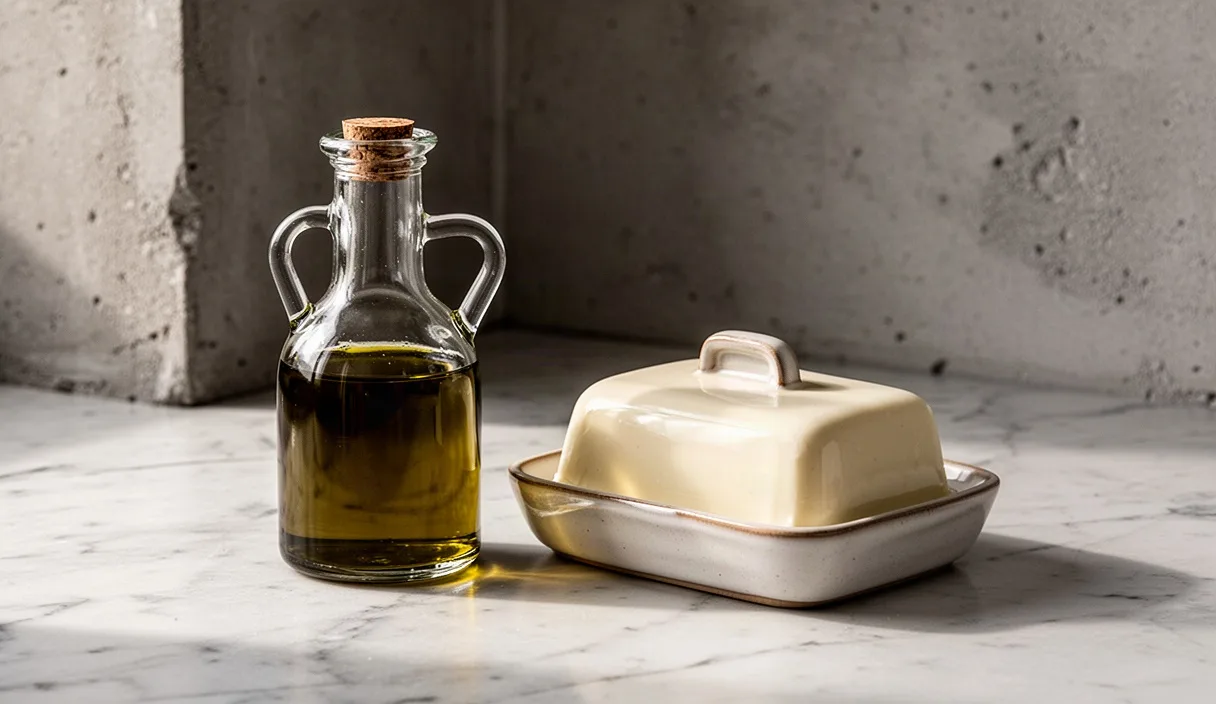
Midlife brings measurable shifts in hepatic lipid handling, vascular elasticity, and hormonal baselines. Between ages 40 and 60, clearance rates for circulating atherogenic particles often slow down. The dietary fats you add to a skillet or drop onto a plate alter these clearance rates within weeks. Butter and olive oil are the two most common dietary fats in Western kitchens. They carry distinct molecular profiles that change your blood chemistry in different ways.
This guide compares the biochemical properties of butter fat with cold-pressed olive oil. It explains how each fat interacts with lipid markers like Apolipoprotein B, low-density lipoprotein cholesterol, and arterial inflammation. It also provides exact cooking temperatures, physical substitution ratios, and kitchen protocols designed to maintain metabolic stability.
Fatty acid classifications: saturated versus monounsaturated fats
Dietary fats are triglycerides composed of three fatty acid chains bound to a glycerol backbone. The bonds along the carbon chain determine the shape of the molecule, its melting point, and its behavior inside human liver cells. Saturated fats contain carbon atoms linked entirely by single bonds. Each carbon carries its full capacity of hydrogen atoms. This straight configuration allows the molecules to pack tightly together, which makes them solid at room temperature.
Monounsaturated fats possess one double bond along the carbon chain. This double bond introduces a rigid bend into the molecule. The bend prevents tight packing, keeping the oil liquid at typical indoor temperatures. Extra virgin olive oil consists primarily of oleic acid, an 18-carbon monounsaturated omega-9 chain. Dairy fat consists of a broader spectrum of saturated chains, alongside water and trace milk solids.
| Fat Source | Monounsaturated Fatty Acids (MUFA) | Saturated Fatty Acids (SFA) | Polyunsaturated Fatty Acids (PUFA) | Primary Fatty Acid Component |
|---|---|---|---|---|
| Standard sweet cream butter | 26 percent | 63 percent | 4 percent | Palmitic acid (16:0) and Myristic acid (14:0) |
| Extra virgin olive oil | 73 percent | 14 percent | 9 percent | Oleic acid (18:1 cis-9) |
Palmitic acid and myristic acid dominate the saturated fraction of butter fat. These specific saturated chains exert a direct regulatory effect on cell surfaces. Oleic acid, the dominant fat in olive oil, does not bind tightly to cell membranes in the same manner. It preserves membrane fluidity, which alters how receptors process cholesterol in the bloodstream.
Impact of butter on circulating ApoB and low-density lipoproteins
Butter alters blood lipid values primarily through its effect on low-density lipoprotein (LDL) receptors in the liver. When you consume high amounts of myristic and palmitic acids, the liver suppresses the activity and recycling rate of these surface receptors. Because there are fewer active receptors to pull LDL particles out of circulation, the particles remain in the blood for longer periods. This mechanism raises measured LDL cholesterol (LDL-C).
A standard lipid profile measures the total weight of cholesterol inside these particles, but particle count provides a clearer picture of cardiovascular risk. Apolipoprotein B (ApoB) is the structural protein found on the exterior of every atherogenic particle, including LDL, intermediate-density lipoproteins, and very-low-density lipoproteins. Each atherogenic particle carries exactly one ApoB molecule. Therefore, an ApoB test counts the exact number of circulating arterial-infiltrating particles.
- Downregulated hepatic uptake: Butter fat slows the clearance of ApoB particles, allowing them to undergo longer periods of systemic circulation.
- Particle size alterations: While butter can produce larger, buoyant LDL particles, it frequently increases the total ApoB count. Total particle concentration drives arterial wall penetration more than particle diameter.
- Clearance via monounsaturates: Substituting oleic acid for saturated fats prevents the downregulation of the LDL receptor, maintaining normal clearance rates of ApoB from plasma.
In midlife patients, a transition from an olive-oil-dominant baseline to a butter-dominant baseline often produces a rise in ApoB within four to six weeks. A clinical practitioner should evaluate your ApoB and LDL-C trends together, because absolute particle numbers dictate the rate of subendothelial retention in arterial walls over time.
Antioxidant content of cold-pressed olive oils versus dairy fats
Beyond fatty acid backbones, unrefined fats carry minor polar compounds that alter systemic inflammation and lipid oxidation. Extra virgin olive oil contains a dense concentration of hydrophilic phenolics extracted directly from the olive fruit pulp. Dairy fat contains fat-soluble vitamins derived from the cow's feed, but lacks plant-derived phenolic antioxidants.
Cold mechanical pressing preserves the natural polyphenols in olive oil. These compounds are destroyed or removed when oils undergo chemical solvent extraction, bleaching, or deodorization. Dairy fat carries small concentrations of conjugated linoleic acid and butyrate, alongside fat-soluble vitamin A and vitamin E, but its total antioxidant capacity remains low compared to fresh, high-phenolic plant oils.
| Compound Group | Primary Source | Specific Active Compounds | Biological Function |
|---|---|---|---|
| Secoiridoids | Extra virgin olive oil | Oleuropein aglycone, Oleocanthal | Inhibits cyclooxygenase enzymes; protects lipids from peroxidative damage |
| Phenolic alcohols | Extra virgin olive oil | Hydroxytyrosol, Tyrosol | Scavenges reactive oxygen species; limits oxidation of circulating LDL |
| Short-chain fatty acids | Butter fat | Butyric acid | Serves as an energy substrate for colonic epithelial cells |
| Retinoids and Carotenoids | Grass-fed butter fat | Beta-carotene, Retinol | Supports mucosal tissue integrity and visual pigments |
Oxidized LDL particles trigger the inflammatory cascades that lead to plaque accumulation in midlife vessels. The hydroxytyrosol and oleuropein present in quality olive oil integrate into the particle shield. This presence slows down the chemical oxidation of circulating lipids, reducing foam cell formation inside arterial tissues.
Cooking temperature limits and smoke points for home kitchens
Every cooking fat has a thermal ceiling where its volatile components break down. The smoke point marks the visible production of volatile gases, free fatty acids, and acrolein. However, oxidative stability under prolonged heat does not correlate with the smoke point alone. Fatty acid composition and antioxidant concentration determine how quickly a fat forms harmful lipid peroxides.
Standard sweet cream butter has a relatively low smoke point between 150 and 175 degrees Celsius (300 to 350 degrees Fahrenheit). The milk solids, specifically lactose and casein proteins, burn rapidly at medium heat. Clarified butter (ghee) strips these milk solids out, pushing the theoretical smoke point up to 250 degrees Celsius (482 degrees Fahrenheit). However, the underlying saturated fatty acid profile remains completely unchanged.
Extra virgin olive oil displays a smoke point between 190 and 210 degrees Celsius (375 to 410 degrees Fahrenheit). Despite containing lower smoke thresholds than refined seed oils, extra virgin olive oil resists oxidative degradation exceptionally well during standard home cooking. Its high monounsaturated fraction resists bond cleavage, and its native phenolic antioxidants sacrifice themselves to neutralize free radicals formed in the pan.
- Keep stovetop settings to medium: Most domestic stovetop sauteing occurs between 160 and 180 degrees Celsius. High-quality olive oil remains stable inside this window.
- Preheat the pan dry: Bring your stainless steel or cast iron surface to cooking temperature before pouring your oil. This limits the total duration the oil sits under direct thermal load.
- Discard burnt fat immediately: If butter turns dark brown or an oil produces continuous blue-tinted smoke, discard the pan contents. Thermal breakdown generates mutagenic aldehydes that strain liver clearance pathways.
Practical substitutions for pan cooking, roasting, and baking
Transitioning from butter to olive oil requires adjustments for water content and viscosity. Butter consists of approximately 82 percent fat, 16 percent water, and 2 percent milk solids. Olive oil contains 100 percent lipid molecules without water. If you replace butter with olive oil at a strict one-to-one ratio by volume, your food may become overly greasy or lose its structural balance.
Use an 80 percent conversion volume when moving from butter to olive oil. If a recipe calls for 100 grams of butter, substitute 80 grams of olive oil. For volume-based home cooking, use three tablespoons of extra virgin olive oil for every four tablespoons of butter specified.
Stovetop and Pan Cooking
Coat the cooking surface with olive oil using a silicone brush rather than free-pouring. When cooking eggs, sweat them at low temperatures in olive oil to prevent edges from crisping excessively. If you require the browning flavor typical of butter, finish the dish with a single teaspoon of melted butter at the very end of cooking, after removing the pan from the heat source. This practice drastically cuts saturated fat intake while preserving familiar taste notes.
Vegetable and Protein Roasting
Toss root vegetables, brassicas, and lean meats directly in olive oil before placing them on a baking sheet. Set oven temperatures between 190 and 205 degrees Celsius (375 to 400 degrees Fahrenheit). Olive oil creates a heat-conductive barrier that promotes surface caramelization without scorching the surface sugars, a problem common with unclarified butter.
Baking Adjustments
Olive oil integrates well into dense baked goods, quick breads, muffins, and yeast doughs. It produces a tender crumb because liquid fat coats flour proteins more thoroughly than solid fat, limiting gluten formation. Do not use olive oil in baked goods that rely on creaming butter and sugar for aeration, such as flaky pie crusts, traditional shortbread, or airy layer cakes. Those recipes depend on solid fat crystals to hold tiny air pockets inside the dough structure.
Common mistakes
Midlife adults altering their dietary fats frequently run into specific implementation errors:
- Switching entirely to clarified butter (ghee) under the assumption that it protects lipids: Ghee removes dairy proteins and lactose, which helps lactose-intolerant individuals. However, ghee concentrates the saturated fatty acids and oxidizes cholesterol molecules when subjected to high heat during its production. It remains an agent that elevates ApoB.
- Buying low-grade refined olive oil: Bottles labeled as "pure olive oil" or "light olive oil" have undergone chemical refining. They retain the monounsaturated oleic acid profile, but they lack the polyphenols, secoiridoids, and hydroxytyrosol that prevent particle oxidation. Choose products labeled "extra virgin" with a clear harvest date printed on the glass.
- Overlooking caloric density: Olive oil and butter are both calorie-dense fats. One tablespoon of olive oil provides roughly 120 kilocalories; one tablespoon of butter provides roughly 102 kilocalories. If you pour olive oil without measuring, your total energy intake will rise, potentially driving weight gain and liver fat accumulation regardless of the improved fatty acid profile.
- Storing olive oil on the kitchen counter in clear containers: Ultraviolet light and heat decompose polyphenols rapidly. Keep oil in dark glass bottles or tins, stored inside a closed pantry away from the stove.
Practical next steps
If your midlife blood work shows rising LDL-C or ApoB, adjust your fat intake systematically and verify the biological result with concrete metrics.
Audit your kitchen fats. Measure out three tablespoons of extra virgin olive oil into a small pourer to cover your daily cooking needs. Remove hard butter from your countertop dish, reserving it in the refrigerator strictly for dishes where structural texture cannot be achieved through other means.
Maintain this dietary baseline for eight to ten weeks. During this period, track your intake to ensure that your total daily saturated fat remains under seven to eight percent of your total daily calories. Consult a qualified medical practitioner or registered dietitian to order an advanced lipid panel. The panel should explicitly include Apolipoprotein B, high-sensitivity C-reactive protein (hs-CRP), and baseline triglycerides. Compare these numbers against your historical butter-heavy values to observe how your personal clearance physiology responds to the substitution.